


In the spring of 2009, three guys stood over a five-gallon paint bucket holding seven fresh oyster mushrooms. University of California, Berkeley, Haas School of Business students Alex Velez and Nikhil Arora were in the kitchen of Alice Waters’ Chez Panisse, a San Francisco Bay Area institution and arguably the birthplace of California cuisine. Although they knew next to nothing about gourmet mushrooms, they had just discovered a unique way to grow them. All they needed now was an expert’s opinion on the make-or-break factor: taste.
Cal Peternell, the restaurant’s co-chef, plucked three — half of the duo’s entire inventory — and tossed them in a pan. After tasting them, he nodded in approval, marking the beginning of a mushroom-filled adventure for the two students.
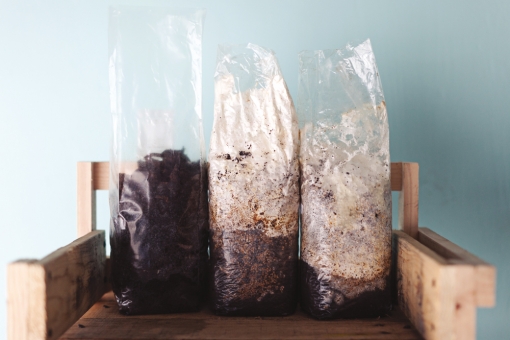
BTTR Ventures (pronounced “better” and short for Back to the Roots) was formed soon after by Velez and Arora, who had met fortuitously just a few weeks before. In a class about reusing materials and ethical business practices, they learned that mushrooms could be grown from recycled coffee grounds. Eager to test the theory, they rigged up 10 paint buckets in Velez’s fraternity house and started growing.
Less than two years later, the BTTR guys hope to bring specialty mushrooms to the masses, beyond the shopping carts of foodies, vegetarians and Asian households. American consumption of mushrooms is steadily increasing, with 862 million pounds sold in 2010, up 9 percent from the year before, according to the National Agricultural Statistics Service.
While most Americans buy the white or brown button variety, 7.7 million pounds sold were oyster mushrooms, and the biggest mushroom lovers by far are Asian Americans and Pacific Islanders, who consume an average of 8.9 pounds per person, per year — more than twice the national average. Analysts at the USDA Economic Research Service are taking seriously the rapid population growth of Asian American communities, calling it “potentially important to the mushroom industry.”
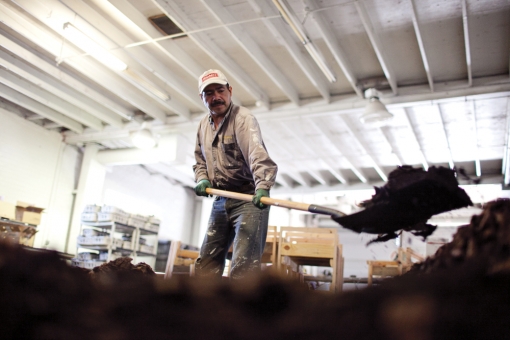
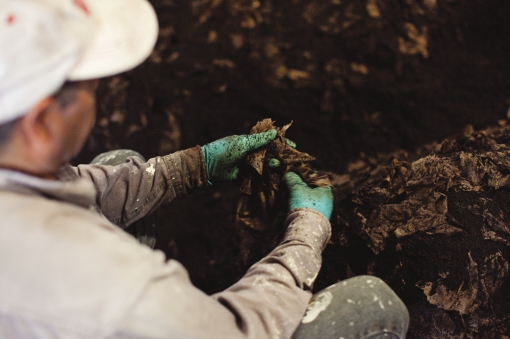
Every day, BTTR Ventures collects used coffee grounds
from local cafes (baristas pay them to divert roughly 32,000
pounds per week). They then process the coffee grounds at their
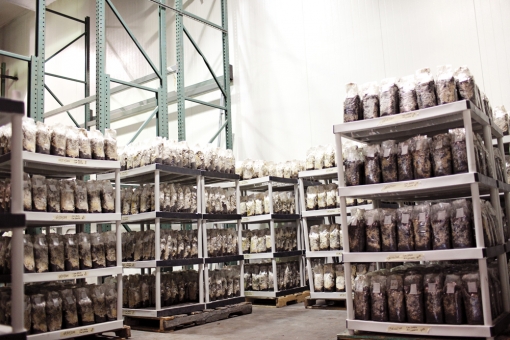
10,000-square-foot indoor farm in West Oakland, CA, into condensed
bricks that mimic natural wood logs, the typical habitat for
mushrooms-to-be. After being injected with mushroom spores,
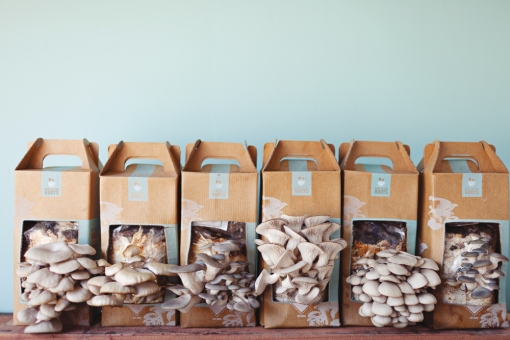
the bricks either produce mushrooms for wholesale customers or
are packaged and sold as BTTR’s signature home mushroom kits.
These do-it-yourself mycology lessons are available online and at
Whole Foods and other grocery stores. Leftover coffee grounds
are repackaged as a nutrient-rich compost that is sold or donated
to schools and urban farms.
The founders call their mushroom-growing technique “a sustainable,
closed-loop system” because outputs from one process
become inputs for another, and they hope each step in this cycle
not only increases their revenue but also produces local jobs in
their community. So far, they have created 14 “green-collar” jobs
to operate their urban farm. Velez and Aurora are convinced that
“social entrepreneurship” — companies whose purpose extends
beyond profit to education and social change — is the future.
Schools are their next target market, as they envision curious students
learning about mycology and recycling from this updated
version of childhood ant farms.
Before business school, Velez and Arora worked in banking
and consulting, and their abrupt conversion to sprouting
ivory mushrooms from piles of coffee grounds has attracted
no small amount of attention:
They have been covered by
the BBC and The Wall Street
Journal and have held TEDx
talks. Their unique idea has
also made the rounds of business plan competitions, where
its popularity attracted new mentors and capital investment.
A key early partner was Inner City Advisors (ICA), an Oakland
organization that provides strategic direction around financing,
strategic growth and marketing to inner city businesses focused
on job creation and community reinvestment. ICA offered a stable
of expert advisors composed of business executives and entrepreneurs
as well as opportunities to connect with other innovative
startups in its portfolio, such as Blue Bottle Coffee and Numi Tea.
Sean Murphy, chief operating officer of ICA, calls the duo “remarkable
entrepreneurs” who are also very humble. “They know
what they know, and what they don’t know,” Murphy said. “They
are always calling advisers to problem solve.”
But as they hustle to grow a successful company, they are
also focused on expanding opportunities for other businesses
and community partners, representing a new category of entrepreneurs,
according to Murphy. “They realize that by sharing the
limelight, they make everyone better,” Murphy said.
Case in point: To open their new West Oakland warehouse in
May, BTTR hosted an event that turned into a networking fair for
local businesses. They invited others who are mentored by ICA
(like organic food company Premier Organics) to host tables at
the opening over a festive display of local food and music. “The
energy was great,” Murphy said. “I’ve never seen anything like it.”
To test their claims, I purchased two home-growing kits. The
mushrooms tasted great, but for $20, I could buy plenty more at
my local Asian grocery store. What I really bought was a novel
experience as a first-time kitchen-counter farmer and my first mycology
lesson.
As Arora himself said, “For us, it’s not really about mushrooms.
We hope to inspire people to think about where their food
comes from.”
Jeff Kang works with various K-12 educational organizations promoting smart uses of resources, technology and data. He received an MBA from the U.C. Berkeley Haas School of Business, and now lives in Washington, DC with his lovely wife and tiny dog.



Comments