


“A
man without history is a tree without roots” -- so begins Vietnamerica, a mesmerizing and moving graphic memoir by Gia-Bao
Tran. GB, as the author calls himself, has been growing up in South
Carolina ignorant of (and indifferent to) the events that uprooted his parents
from Saigon and transplanted them to the United States. Only at the death of
his grandparents, thirty years after his parents flee Vietnam, does GB visit
Vietnam for the first time. There he will discover the remnants of family and
friends who stayed behind, and will piece together their heartbreaking
histories, entwined with the history of the land, to finally understand the
scars left on his family.
The book is beautifully, lovingly, rendered. GB is a master illustrator and
cartoonist, effortlessly varying techniques -- cartoons, line drawings, block
prints, water colors -- to capture his story, from the serenity of Vungtau
where his parents lived a few idyllic years before they fled Vietnam, to the
starkness of the terror and destruction inflicted by Vietnam’s many wars, to
the chaos of the burgeoning modern Vietnam he finds when he lands there.
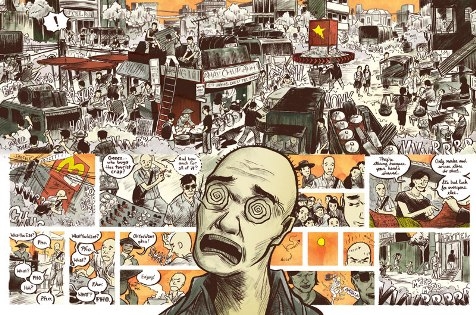
Particularly
impressive are various full page illustrations that stop the narrative, as
though stopping time itself so that the moment can be experienced in all its
complexity, sometimes zooming out to include the entire scene, sometimes
zooming in to present details. In one stunning depiction of the migration of
his mother’s family from the north to the south, GB does both: The top panel,
spread across two facing pages, is the actual migration: people fleeing,
carrying their belongings and children, while being targeted by soldiers with
bayonets, with airplanes flying overhead dropping parachutes from the sky. The
wide bottom panel is the destination: a placid sea, coconut trees, and a family
calmly enjoying the vista from a hillside, showing not a hint of any of the
preceding turmoil. And in between the two panels are close-ups of people’s feet
during the migration, some with slippers, some barefoot, walking through rain,
over rocks, through puddles. The page is prefaced by his mother’s words: “I was
too young to remember, but that couldn’t have been an easy journey.” The
pictures are, of course, all drawn by GB, and even though these scenes in the
past are doubly imagined, the pictures appear to have all the power and
authority and authenticity of a lived collective memory.
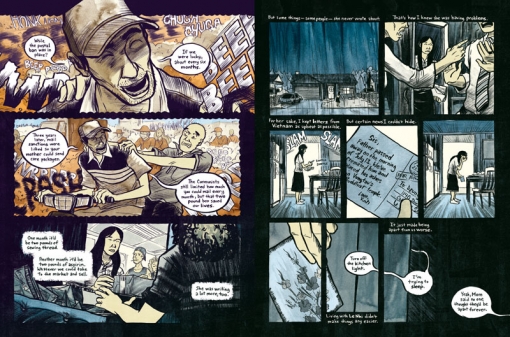
The narrative alternates between the present (the path to GB’s discovery of his
history) and the past (narrated by his mother, father, and uncle, amongst
others), spiraling towards that final moment of uprooting, in an airport in
Saigon waiting to board a plane to America, where GB will be born. Included are
details: GB’s paternal grandmother’s opportunistic affair with a French Colonel
when his grandfather deserts her to join the Vietminh, so she can bring her
family up safely; his maternal grandmother’s career as a baker; the efforts of
an American who befriends his father before the fall of Saigon and is
instrumental in his escape to America; his father’s friend’s inability to
escape and subsequent deportation to a labor camp for six years when the
Vietminh take over; the difficulty of contacting family and friends who did not
manage to escape. The various narrative threads, and the tangled telling of
them, threaten to overwhelm the memoir at times -- that they don’t do so, is
largely because it doesn’t seem to matter which war is currently besetting the
populace, who the enemy is, who is seeking to incarcerate, who is forced to
flee -- the resulting upheaval destroys lives regardless.
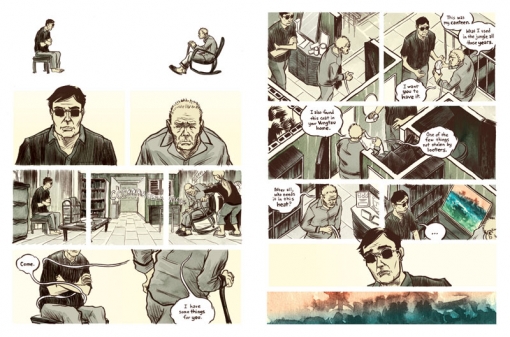
A central thread in the memoir is GB’s strained relationship with his sometimes
harsh and remote father, and the memoir seeks to understand his father’s
character as it simultaneously tries to uncover the history leading to his
father fleeing Vietnam. GB discovers various clues: his father’s strict and
unsympathetic upbringing by his mother; his grandmother’s disapproval of his
father’s career as an artist in Vietnam, much in the same way his father is now
reluctant to endorse GB’s career as an illustrator and writer; his father’s
strained relationship with his own father who returns, after his son has fled
to America, as part of the victorious Vietminh; his father’s torture at the
hands of the French while being interrogated regarding the whereabouts of his own
absconding father.
Ultimately, the book is as much about understanding the scars carried by
families as it is about discovering the history that inflicted them. The
history of a land is tied to the history of its people, and thus to the history
of its families -- this beautiful and moving book is thus also a tribute to the
strength of families, and the bonds that strive to survive the uprooting.
* * *
GB Tran will be appearing at the following events:
Nov. 17: public talk and class visit at the University of Illinois in Chicago
Nov. 18-19: panels at the National Council of Teachers of English in Chicago
Nov. 30: public talk and Vietnamerica exhibition opening at Mercer Gallery in Rochester
Nawaaz Ahmed is a transplant from Tamil Nadu, India. He holds a PhD in Computer Science from Cornell University, and an MFA in Creative Writing from the University of Michigan, Ann Arbor, where he won Hopwood awards for his short stories, non-fiction, and his novel-in-progress.

Comments