


Since I was very
young, I have seen photographs of Jerome, AR. In one, my grandmother is
standing in front of a black tar paper-covered barrack. She is holding my
infant mother, who is wrapped in a wool blanket, a white cap on her head. There
are icicles hanging off the rooftops. The landscape in these photographs is
stark: miles of farmland and swamps, massive dark foliage and the visible chill
of the Arkansas winters.
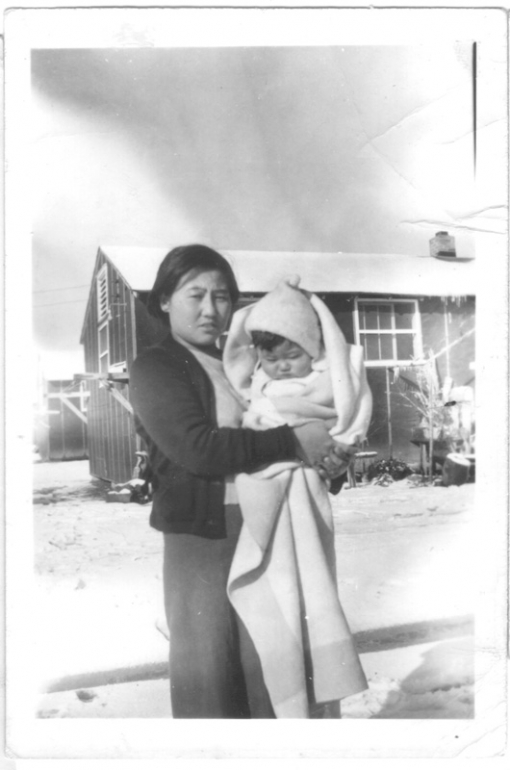 The writer's grandmother and mother at Jerome, 1943. Courtesy of the writer.
When I first heard about Drama
in the Delta, a new video game that takes place at the Arkansas Delta
internment camps for Japanese Americans, I wondered how — or if — it was
possible to construct a video game from an experience that I understand, as the
daughter and granddaughter of Jerome internees, as a time of irretrievable and
traumatic loss.
But Drama in the Delta —
a collaboration between the Supercomputer Center and the theater department at
the University of California, San Diego — turns out to be a surprisingly moving
experiment in historical simulation. This past summer, a free download of the
game’s initial level became available on dramainthedelta.org, allowing players
a 3-D glimpse into the lesser-known Jerome and Rohwer, AR, camps, the only
detention centers located in the racially segregated South.
The game’s first mission — additional levels will be released
as the project receives further funding and public feedback — establishes
the setting and mood of the Southern camps. The game
takes place in 1944 on a day that the majority of internees are leaving
Jerome. Players run through the empty camp as Nisei teenager
Jane on a mission to retrieve beloved objects accidentally left behind.
There is a sense of the desolation and repetitive nature of the
space, the blocks upon blocks of barracks.
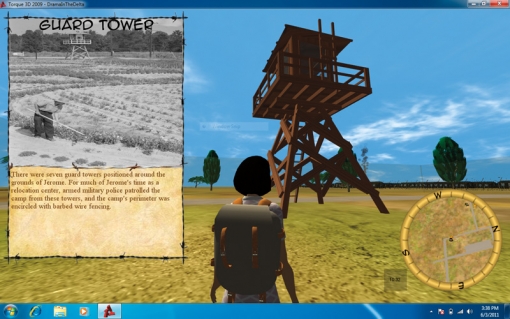 Jane approaching a guard tower at Jerome, in her search of her friend Akiko's belongings.
Delta is part of a genre of social justice-oriented gaming, which
capitalizes on the ability of a video game to be both an aesthetic
and educational experience. Websites like Games for Change
(gamesforchange.org) showcase digital games that draw upon the
expertise of academics and designers alike and intend to educate
audiences about history and social issues by immersing players in
visually stunning, elaborately fashioned worlds.
Jeff Ramos, a content manager for Games for Change, says that
such social justice-oriented gaming allows for deeper levels of interactivity.
“The ability to enter a different world and affect it, and be
affected by it, creates a unique form of impact and understanding
not commonly found in traditional media,” he says.
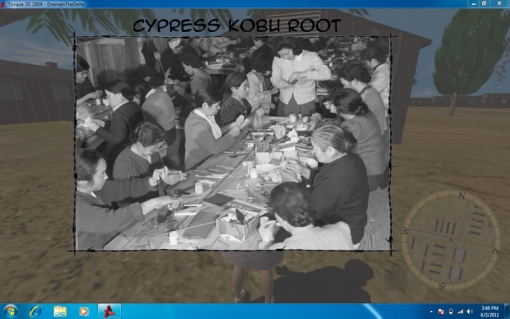 Photograph of internees creating sculptures from kobu, the root growths of cypress trees.
Emily Roxworthy, a theater professor at UCSD, leads the Delta
project, and her research on the internment camps serves as the
historical and theoretical foundation for the game. While a graduate
student at Cornell University, Roxworthy started her investigation
on the role of performance — such as in Kabuki and Noh theater
— by prisoners in the internment camps. Such performances, Roxworthy
says, were a means of resistance against the scrutiny of
camp administrators and the public at large.
The video game centers on these performances and is populated
by scenes and characters as wide ranging as African American
day laborers who also sing in a blues group, Nisei teenagers
performing Kabuki and a “Womanless Wedding,” a long-standing
Southern tradition where men dress in drag and act out a wedding
ceremony.
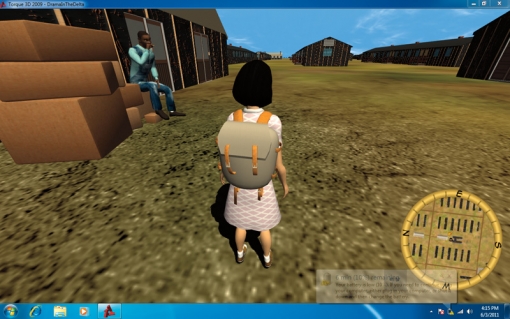 Jane with John, a day laborer at Jerome.
The game also explores how the Jerome and Rohwer camps
were located at a complex nexus of race relationships in the American
South. In one mission that has yet to be released, Kenji, a soldier
in the 442nd all-Japanese American army regiment, arrives in
Hattiesburg, MS, and is directed to take a bus to nearby Jerome
for R&R. Caught in the middle of a black-and-white racial order, the
game requires Kenji to choose whether to sit at the front of the bus
with the whites or at the back of the bus with blacks.
“[Japanese Americans] were usually allowed, if they were willing
to accept it, the privilege of being white,” Roxworthy says, adding
that this scenario was based on historical accounts. However, most
Japanese Americans struggled against that “privilege”; they could
see what was happening to African Americans was unjust. “To pit
themselves against African Americans seemed wrong,” she says.
Roxworthy argues that the exposure of Japanese Americans
(who came from Los Angeles, Sacramento and California’s Central
Valley) to the blatant racism of the Jim Crow South may have
spurred later activism by internees. Civil rights pioneer Yuri Kochiyama,
Roxworthy says, was interned at Jerome, and she witnessed
firsthand the stark segregation between blacks and whites while
performing a play she composed to white audiences outside of the
camps.
In addition to replicating the era’s race relations, the team at
UCSD’s Supercomputer Center strived for authenticity in constructing
the visual world of the camps. They drew upon blueprints and
archival photographs to meticulously re-create the 3-D world of
Jerome. But the tendency of 3-D graphics to look plastic and sterile
made it difficult to create a faithful representation. One former
Jerome internee who consulted with the UCSD team on the game
found that the camp looked too clean and perfect. “We spend a lot
of time trying to degrade the environment,” Roxworthy says.
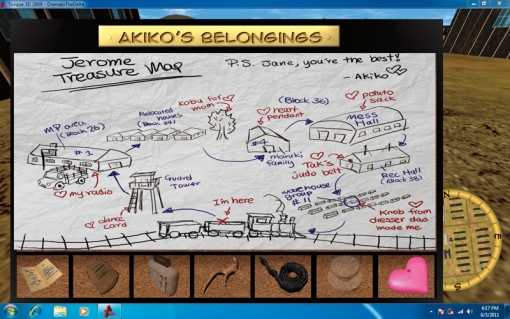
A map of Jerome camp, with the locations of Akiko's various belongings.
Despite efforts to make the game historically accurate, including
integrating informational passages and photographs into the
missions, there remain potential pitfalls in creating a video game
around a weighty historical topic such as the internment. “The
idea that the game would be all that someone might learn about
the camps is really troubling,” Roxworthy says, pointing out that
the Delta website provides more historical information and links
to resources.
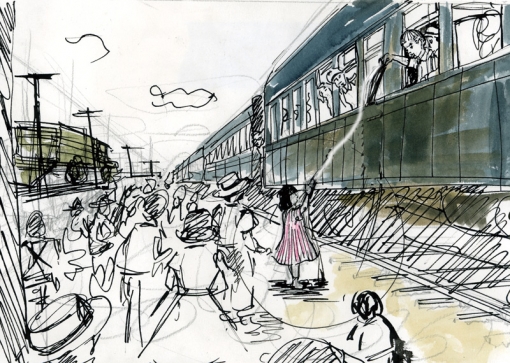
A storyboard, used in the planning stages of game, of Jane holding on to one end of a paper streamer as a train is about to depart Jerome.
Ultimately, Roxworthy hopes Delta will provoke an emotional
reaction among players, namely empathy with the character being
played. When I finish the first mission, an animation plays of a train
about to depart Jerome. Passengers uncoil rolls of paper streamers
to those who stand below, those who will remain in the camp. As
the train leaves the station, the streamers become taut and break.
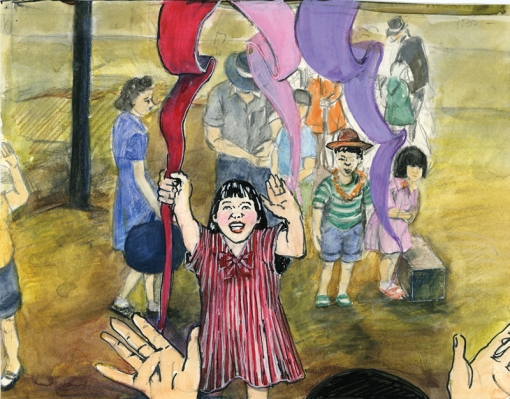 Illustration of Jane grasping at streamer.
I am participating in a moment, in a place that I have only known
through black-and-white photographs. I am seeing Jerome in color
for the first time. And it is a remarkable sight.
Cathlin Goulding is a books editor for Hyphen. She last wrote about Mr.
Hyphen 2010, Kyle Chu.



Comments