


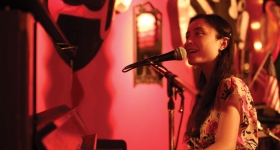
In anticipation of our 25th Issue/10th Anniversary celebration, Hyphen talks with musician, scholar, educator, and community leader Senbei a.k.a. Colin Ehara, who will be performing at Hyphen's Generations: 25/10 bash on June 30 in San Francisco.
Senbei answered some questions over email about how his relationship to hip-hop began, how he perceives his role as an Asian American hip-hop artist, and who and what inspires him.
Tell us about your musicality. How did you decide this is what you wanted to do?
Hip-hop has been one of my greatest teachers (and saviors in
many ways). I grew up in Richmond, Calif., a working-class suburb about 20 minutes from
Berkeley and Oakland. I don't believe for a minute that I
"chose" hip-hop as a culture and practice because in the predominantly people-of-color community I was born and raised in, hip-hop was and continues to be
everywhere. In the fourth grade, I was given two cassette singles
(remember those?) from various homies. The first was Public Enemy's
"Can't Truss It," about attacks on Black communities
that discussed everything from the legacy of slavery, crack cocaine and the
prison industrial complex to funk rhythms and activists like Malcolm X. The
second tape was of Sir-Mix-A-Lot's "Baby Got Back," a (non-PC) ode to the female derriere. While most would argue that being
introduced to these things at such a young age isn't a positive thing,
I grew up around many folks who were being bombarded by much worse at even
younger ages, and to this day, I deeply appreciate the ways I was introduced
to hip-hop's (and I would add humanity's) circular conflict when dealing
with various forms of oppression. Life is messy, scary, beautiful,
hilarious and everything in between, and hip-hop's willingness to courageously
stare it all in the face (over infectious drums and syncopated
rhythms) drew me in instantly. I began DJing at age 16 and had been writing poetry since the age of 14. I put it all together – producing beats
and rapping – when I met emcee Jeimil Belamide at
UC Santa Cruz, where we formed the group Braindrops (later Broken Halos).
How do you feel about being an Asian American musician today?
Being an Asian American in hip-hop is a beautiful struggle.
It involves, for me at least, a constant state of reflection on various and
varying forms of oppression. I am always working (imperfectly) to remember the
ways I am a guest in a historically Black/African heritage art form and culture
and that hip-hop was born of poverty and of folks being targeted, in
many ways, for destruction in the U.S.(check out Jeff Chang's Can't
Stop; Won't Stop: A History of the Hip-Hop Generation). Historically,
Asian/Pacific Islanders have had many common experiences with African Americans
here and abroad in the face of white supremacy, but because of the way media
outlets often portray our community as "culturally functional"
but always foreign, and Black American communities as American but
"culturally dysfunctional," we are often divided from one another. And
amnesia regarding our common ties is allowed to consume us, unfortunately.
Also, in a culture and art form that is marketed as violent and hyper-masculine/sexual, I am many times deemed a perpetual foreigner in the realms of hip-hop as well, as an Asian male who, like his other brothers, has been historically/presently emasculated and desexualized in many ways (through laws, public policies, the media, etc.). As a mixed heritage Japanese/Scottish/German/Iroquois
American, my ethnic ambiguity can at times leave me less likely to be
challenged when stepping into hip-hop spaces, but this "acceptance"
is primarily inauthentic because it can come through not being recognized for
what I and who I truly am. Creating a balance between being
mindful about my privilege/s as a mixed heritage Asian/Japanese American while pushing to carve out space for my voice and story to be heard is a
beautiful struggle.
Who are your main
influencers?
My community. My family – immediate and extended. My grandparents.
My wife/Sensei/life-partner, Emalyn Lopez; my parents, Paul and Alison; my
brother, Akiyoshi, and my sister, Lalin, are the most courageous, kind and
thoughtful teachers, artists and lovers of justice I've ever known. My friends
are too many to name here but they know who they are and what they've meant to
me in my blessed life. Whether homies,
teachers, professors, mentors, fellow artists, colleagues or allies,
my non-blood-related family members play an instrumental role in everything
that I am and strive to do and be. In this period of my life, my biggest
influences are by far and away, my students. I am quite sure that I learn more
from them than they do from me. With regards to musicians and artists: Emalyn
Lopez, 2Pac, Little Dragon, Arundhati Roy, Nas, Chris Hedges, Andre3000,
Lupe Fiasco, The Seshen, Power Struggle, DJ UN.D.FINE, Liza Gesuden,
Kendrick Lamar, Tadashi Nakamura, Wu-Tang, E-40, Native Guns, Blue
Scholars, Jeff Duncan-Andrade, iLL-Literacy, Haruki Murakami, Yuri Kochiyama,
Malcolm X, MLK, Richard Aoki, Al Robles, Budhha G, Wei Ming Dariotis, Jeimil,
Bruce Lee, Tunji, Blooms, Dahi, Wesley Ueunten, James Baldwin, O.P.T.I.C.,
M.I.A., Allyson Tintangco-Cubales, Radiohead, The Roots, Peter Nathaniel
Malae and an ongoing list that is so extensive that it could become a
book.
Is there anything you
feel strongly about, that you're trying to highlight in your music?
To put it simply, in the words of Dr. Martin Luther King, I
am trying with all my might, "to disturb the comfortable and comfort the
disturbed." This by all means, includes myself (on both ends).
If I were to turn on
your iPod right now, what five artists/songs would I see on your recently
played list?
Kendrick Lamar
Buddha G
The Seshen
Little
Dragon
Frank Ocean
Since it's Hyphen's
10th anniversary, please humor us by telling our readers why you decided
to come support us by performing!
Plain and simple, I love my people/family/community. I think
we all always have room to grow, mature and develop and should be pushing
towards such, but we also need to celebrate and remember our successes and
victories. 10 years of Hyphen is HUGE and undeniably deserves revelry. A
strong community of golden/brown/yellow sisters and brothers
have been volunteering their valuable time and energy to ensure our
communities don't fade into the shadows of America (and beyond). These imperfect
pushes toward love and justice have and continue to help me hope and cope
during a recession, two wars and an increasingly growing wealth/health
disparity. I'm honored to be sharing the space with such a brilliant and
resilient people/family/community.
...
Responses have been edited and condensed by Hyphen staff. See Senbei perform at Hyphen's Generations: 25/10 bash on June 30 in San Francisco.

Comments