


Just over twenty years ago, the Los Angeles Riots caused nights
to glow orange from thousands of arson fires, and ash to fall from the sky like
dirty, gray snowflakes.
I remember it well: I
was a scared high school junior in Long Beach, California, where whole city
blocks were torched and camouflaged National Guardsman and their armored military
vehicles rumbled down civilian streets.
It’s this mood and tone that filmmaker Matt Ford seeks to
capture in his retrospective documentary Uprising:
Hip Hop and The LA Riots, which aired on May 1 to coincide
with the Riots’ 20th anniversary (see it free on VH-1 here).
The one-hour documentary is an uneven treatise that suffers
from a weak analysis of the uprising that killed 54 people and caused over $1
billion in damages. Of course, it was
made for mainstream cable TV station VH-1 and narrated by my high school
schoolmate Snoop Dogg, so it’s not like I expected a nuanced discussion. But still.
The central thesis is this: Black and brown communities had been abused by the LAPD for years. Rappers like Ice-T and groups like NWA documented this abuse in their songs, but no one listened. When the officers were acquitted, it was the
spark to the powder keg of an already angry and disenfranchised community.
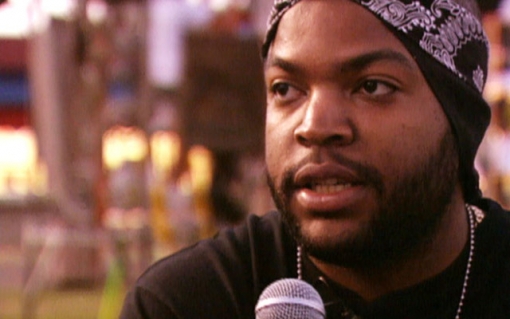
Rapper Ice Cube in 'Uprising'
Through the course of the documentary, West Coast rap
luminaries such as Snoop Dogg, Ice-T, Eazy-E, Dr. Dre, Ice Cube, and Kurupt give
us their thoughts and perspectives on the riots. (The interviews with East Coast rappers KRS-One and Nas are unnecessary distant
voices and seem more like “Cool People I Know” add-ons).
It’s a who’s-who of the West Coast music scene, but the film
could have provided better insight on the big picture causes of the riots. You know you’re struggling when your
“experts” are talk show host Arsenio Hall (a strange choice thematically) and
USC Professor Todd Boyd (a sensationalist choice due to his shock value statements in the documentary and his self-given
nickname, “the Notorious PhD”).
If Ford had a chance to do a longer director’s edition, I’d
suggest a convo with MacArthur Award winner Mike Davis, who practically
predicted the riots (just like Ice Cube and NWA) in his seminal history of Los
Angeles, City
of Quartz.
And when Ford discusses the violent history of the LAPD and
Chiefs Parker and Gates, he can’t just leave them alone on an island, can he? The police don’t work in a vacuum and it
would have taken a simple GIS map of L.A. with income
levels and incidents of police violence to illustrate how LAPD’s self-described “Thin
Blue Line” created de facto borders between rich and poor, white and non-white
across Los Angeles. Additionally,
an explanation of how racial covenants legally
segregated Los Angeles and the elimination of post-war manufacturing jobs for
black workers would have enriched the discussion on inequality and
injustice.
There is also little analysis of the role of Latinos during
the riots, which is surprising, given the history of Los Angeles and the Zoot
Suit Riots. For example, many of the initial victims attacked by mob violence at the infamous intersection of Florence and Normandie
were Latino. And according to a 1993
report prepared by the Latinos Futures Research Group, one third to one half of
the businesses looted were Latino-owned.
Ford does give some airplay to the Korean American merchants
who suffered much of the economic and psychological damage of the riots. However, when he quotes a business leader as
saying that Koreatown has recovered to be profitable again, he implies that the
Korean American community is monolithic, and severely overlooks the individuals
and families who never recovered. (Much
of the post-Riot Koreatown recovery came from overseas Korean investors, not
Korean Americans).
And when Ford talks with gunstore owner David Joo, infamous
for being taped shooting at looters, he ends the interview by asking him if the
riots “were good for business?” It’s an
unnecessary “gotcha” question if there ever was one, and left me wondering if
the Korean American segment was a token effort, or worse, reinforced the scapegoating of
Korean Americans. In this
segment, I never got the sense the Korean speakers got a fair shake, and certainly were not humanized
like the other interviewees.
For Ford to leave out the complex narratives of two such key
communities in the diverse racial potpourri of Los Angeles makes him seem
intellectually lazy, stuck on a dated black-white racial paradigm, and/or
perhaps over-reaching with his hip-hop lens of the Riots.
Despite its shortcomings, Uprising does have many successful
moments and crescendos. A killer
soundtrack of West Coast gangsta rap and G-funk provides raw energy, and the rare
on-the-ground footage of looting, beatings, arson, and mayhem strangely mesmerize.
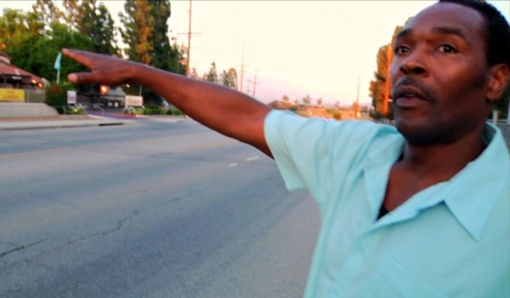
Rodney King revisits the site of his beating in 'Uprising'
Ford’s interview of Henry Watson, one of the notorious “L.A. 4”
who beat white truck driver Reginald Denny, is tense and dramatic, and provides
a human dimension to the arc of the film.
You can’t help but get chills when Watson is asked whether or not he
regrets his actions from twenty years ago. And the closing scene -- with Watson returned to the scene of his crime
and Dr. Dre’s “Lil Ghetto Boy” playing -- forces the viewer to not only look at broader social injustices but also ask
how does a man go from high school football star to United States Marine to drug
dealer to beating an innocent man on live TV?
Twenty years after, I’ve come full circle with my Riot
experiences. I teach at a high school in
South Central Los Angeles, and when I drive around the neighborhood, there are
huge swaths of lots where businesses and furniture stores and markets once
stood.
I asked my students if they knew why those lots were
empty. Born four to five years after the Riots, hardly any of them did. Then I
dimmed the lights and played Uprising. With its infectious beats, brutal imagery,
and vast star power, it was a good starting point for them to begin learning.
***
K-PoP is Hyphen’s newest blog
column and it’s short for Ky-Phong on Pop Culture. Ky-Phong Tran is an award-winning writer and
teacher based in southern California and he’ll be writing about music, art,
literature, Los Angeles, fatherhood, and other musings.




Comments