


Growing up as a Chinese American and a voracious reader, Grace Lin’s favorite children’s books never contained any characters that looked like her. This became her motivation for writing children’s books. Dumpling Days is the third installment
of the semi-autobiographical series chronicling the life and foibles of Pacy
Lin.
I wish Lin’s books had been around when I was younger. I
would have liked hanging out with Pacy and her Chinese American friend, Melody,
exchanging books, eating dinner at each other’s houses, and empathizing with
their navigation of a hyphenated identity.
Ramona Quimby was a good friend to me but she wouldn’t have understood why my
family ate “ugly vegetables” instead of pancakes or why we burned paper money
for our ancestors.
For those who haven’t read the series,
they offer introductions to Chinese American culture through the lens of Pacy’s
family. Every chapter is interspersed with Lin’s wonderfully simple line
drawings and stories within the story.
The situations and conflicts are told from a child’s point
of view so the reader understands them in a larger context even though Pacy
does not. Pacy is just observing that her family does things differently or
that she looks different from everyone else. As the series progresses, Pacy
starts to face bigger problems like self doubt, external racism, and even
internalized racism. As she grows up in each book, she develops a sense of
injustice and realizes that she takes things for granted. She also becomes a
much more realistic, flawed character. However, she learns that growing up is
about recognizing you were a jerk and trying to atone for your mistakes.
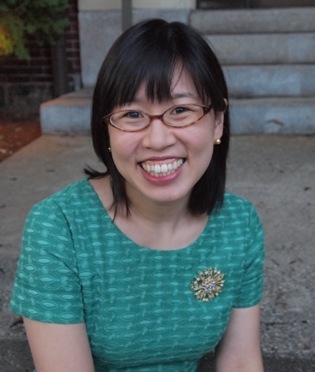
Photo of the author by Alexandre Ferron
Dumpling Days is a
departure from the previous two books -- instead of taking place in their small
town in upstate New York, Pacy and her family go to Taiwan during the summer to
celebrate her maternal grandmother’s 60th birthday.
Lin uses the setting of ghost month to
talk a lot about Chinese superstitions, funeral rites, and ancestral piety. But she also uses ghost month to
explore the confusion of cultural identity. Pacy feels
like an outsider to her white friends yet doesn’t feel Chinese enough because
she doesn’t speak the language. After an incident in which a vendor angrily
questions why she can’t speak Chinese, Pacy says, “I still felt as if I were a
twisted knot. I was angry at all of them -- the bus driver, the convention
girls, the market lady. I wanted to yell, “I’m an American!” but they wouldn’t
have believed me. Inside, I felt hard and stubborn, like a fist clutching a
stolen pearl. I didn’t want to learn Chinese, I didn’t want to paint bamboo,
and I didn’t want to be here in Taiwan. Here, people either despised me or
acted like I wasn’t there, looking through me like a ghost.” I really enjoyed
that little bit of defiance. It is a familiar trope in Asian American
literature, this idea of being in an in-between state, of not belonging to
either world, of feeling invisible like a ghost.
Lin generously describes the meals Pacy eats in Taiwan. Food
seems to be a strong influence in shaping Pacy’s Chinese American identity.
They hit a lot of Taiwanese food highlights like xiaolongbao at Din Tai Fung,
hand-pulled niurou mien, wax apples which tasted “like an apple crossed with a
bubble,” boba (which they call frog eggs), and fried duck tongues at the night
market. Even the corn soup and rice burgers from the Taiwanese McDonald’s were
sounding pretty good. There was a little too much talk about Pacy’s love for
dumplings and I found some of the descriptive charm taken away because it felt
done to death.
If you’re Chinese American, you’ll
appreciate the many ways Pacy’s family is just like yours and if you’re not
Chinese American, you’ll appreciate the many ways Pacy’s family is still just
like yours. This series gives kids and adults a way to connect with a different
culture while still teaching us that we all seek self acceptance
Jenny Yap is a
lecturer in the English Department at California State University, East Bay. She hopes Lin will continue the series and write about a teenage Pacy on a Love Boat adventure.


Comments