


Ayad Akhtar’s first novel, American Dervish, is a coming-of-age story about a young American Muslim, Hayat Shah, who grows up in 1980s Milwaukee. Raised by secular Muslim parents, Hayat's first real
encounter with Islam begins when his mother's best friend from Pakistan, Mina,
arrives with her five-year old son, Imran, to live with the Shahs. For years,
Mina has been nothing but a photograph to Hayat and a character in his mother's
romantic reminiscences of her childhood in Pakistan. Upon entering his life,
Mina not only captures Hayat's heart but also his soul, acting as his teacher
as she navigates him through the world of Islam. Through their nightly readings
of the Quran, Hayat -- who is captivated by Mina's beauty -- also falls in love
with the religion. His religious awakening is thus painfully and often
confusingly enmeshed with his sexual awakening. When Mina begins dating a
Jewish doctor, Nathan, Hayat's jealousy rears its ugly head. At the same time,
Hayat is exposed to anti-semitic sentiments from within his own community, and
soon he begins to regard Nathan not just as a competitor but also as an unfit
human being. Determined to save his beloved Mina, Hayat embarks on a path of
destruction that will not only tear their love apart but also leave him
emotionally scarred for the rest of his life.
In a post-9/11 world, Akhtar's novel is
important for a variety of reasons, chief among them being that Akhtar creates
a portrait of a family that breaks all stereotypes. Hayat's father, Naveed, is
not a mullah (an Islamic cleric) and his mother does not wear a burqa. Instead,
his father, a neurosurgeon, eschews religion, is an alcoholic, and cheats
routinely on his wife. Muneer, Hayat's mother, is an educated psychologist who
gave up her degree to care for her family. She is a firebrand who does not
spare her son from his father's infidelities. While both his parents are
Pakistani immigrants, the family, much to Muneer's chagrin, refuses to
socialize with others from their community.
But what makes the book most compelling is
Akhtar's creation of complex characters. There is no black and white. Naveed, for
example, may be an alcoholic who cheats on his wife, but he also has a heart.
Naveed's soft side is best illustrated in the father-son relationship he builds
with Mina's son Imran, whom he calls "Kurban" much to Hayat's chagrin. "Kurban," an Urdu word meaning "sacrifice," is also used to address a loved one. “It was strange to see father behaving so warmly towards the
boy,” Hayat recalls. “The stinging I felt when I first heard father use the
term of endearment 'kurban' for Imran would recur, and I would grow
accustomed to it.”
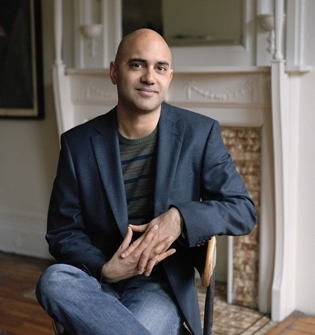
Photo of the author by Nina Subin
Similarly, Mina, who had suffered from the
conservative society and family in Pakistan, is still hopelessly attached to her
religion to the point where she will not consider marrying Nathan until he
converts. This complexity of scenarios is best illustrated in a scene where
Nathan is subjected to an anti-semitic sermon at the mosque while he is
seriously considering a conversion. Naveed tells Nathan:
"I didn't want
you go to because these people are idiots. Plain and simple! They have nothing
better to do with their time than to insult our intelligence. The last time I
suffered through one of Souhef's stupid khutbahs [sermons], that same
numbskull went on about how many years in hell we would have to spend for
telling a lie, and how many years for dishonoring our parents and how many
years for turning our backs on the Afghani brothers fighting the Soviets. He
had it all worked out."
Secondly, while the Quran is a much
maligned book in these modern times, Akthar manages to show us both the beauty
and the darkness of the book by including passages from the Holy Book in his
novel. For those who have only the vaguest idea of what the Quran says, American
Dervish could serve as a gateway into the world of Islamic verse.
Akthar's background as an actor and
screenwriter (he created and starred in the films The War Within and
acted in HBO's Too Big to Fail) is evident in his execution of plot
twists and turns to keep up the pace of the story, as well as in his detailed
description of scenes as they unfold. At times, his prose falters, slipping
into clichés and overly melodramatic turns of phrase. “I slept soundly that
night, held in restful sleep like a baby in a mother's loving arms,” he writes
in the prologue describing a college-aged Hayat's first encounter with eating a
pork sausage. While the prologue and the epilogue hint at a sequel, it may be
superfluous in an otherwise tight and compelling novel.
Ultimately, American Dervish paints
a compelling portrait of a modern Muslim American family that transcends
stereotypes. In many ways, it is an American novel -- the story of a young
American boy who finds both love and God in one eventful summer and risks
losing them both.
Anisha Sridhar is a writer and graduate student at NYU. She also blogs at The Chilli Pepper Review.

Comments