


In December 1992, right-wing Hindus
demolished the Babri Masjid (mosque) at the Hindu holy site of Ayodhya. What
followed was two months of communal carnage where Muslims killed Hindus and
vice-versa. Until then, while India had not been immune to bouts of communal
tension, Bombay had prided itself on being a relatively peaceful city where
religious harmony endured. All that changed in December 1992 and January 1993.
The riots killed at least 900 people, injured 2000 more and changed forever the
cultural ethos of the city.
The World We Found is Thrity Umrigar's sixth novel and a rumination on the effects
of the '93 Mumbai riots on four friends. It is also a story about love, loss
and friendship and spans across India and the US, with flashback sequences
that take us back to a pre-riot Bombay in the 1970s. Originally
from Mumbai, India, Umrigar currently teaches Creative Writing at Case Western
University and is the recipient of the Cleveland Arts Prize.
In late 1970, Armaiti, Nishta, Laleh and
Kavita were best friends in college. They were rebellious, free spirited young
women with a taste for political activism. Fast forward thirty years and
they have all drifted apart. Laleh and Nishta marry their college sweethearts, Armaiti moves to America and marries an
American, while Kavita, a successful architect, is a closeted lesbian. Once
inseparable, they now live lives dominated not by political activism, but by
the more urgent and delicate responsibilities of marriage, family and work. Yet
Armaiti notes in her internal dialogue, “The four years of college now seemed
to have gone by too quickly. There was no real explanation for why she had not
stayed in closer touch after leaving for the US. Unless it was this: coming to
America itself was a kind of defeat -- the inaudible admission that their days
as young radicals had drawn to a close.”
However, when Armaiti learns that she has
an untreatable cancer, she reaches out to her friends in the hopes of seeing
them one last time. Armaiti's request sets off a flurry of memories and
emotions that brings up a series of unresolved events in the women's lives.
Most important of them being the disappearance of Nishta. When Laleh and Kavita
finally track her down, they are shocked to discover the extent to which
Nishta's life has changed. The uncomfortable truth, they discover, is that in her marriage, Nishta not only lost herself
but did not find acceptance in her husband's Muslim community either.
Nishta is not
the only one who has lost something, however. Like Nishta, her friends have also lost
the world of their idealistic youth, ultimately inheriting something very different.
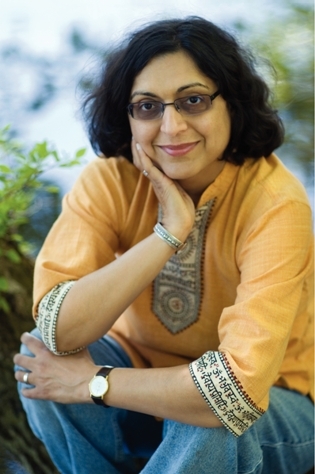
Photo of the author by Robert Muller
Umrigar never fully explains the riots. She
doesn't need to. Instead, she demonstrates the effects of the riots through her
characters and how it changes them, making both the story and her characters
that much more powerful. This untold story, however, explains her characters'
choices and their dilemmas; it humanizes them. This is
especially poignant in her portrayal of Nishta and her husband Iqbal. It would be easy to
dismiss Iqbal as an extremist but against the backdrop of the riots, his
choices become less radical. In a passage about the violence, he explains, “Everyone we knew had lost someone or something. And I -- married to a
Hindu girl -- I had always been so proud of what Zoha and I had done. And now I
felt like everything I had ever believed in -- socialism, secularism --
everything felt like a joke.”
Umrigar also relies on suspense to keep the
pace of story. There are secrets exchanged between old friends, problems that
have no easy solutions and the tragedy of Nishta's situation. As
much as the story is about Armaiti's illness, soon it becomes about freeing
Nishta from her virtual prison. Umrigar switches between her characters'
perspective regularly to present the story from different angles. In the hands
of a less capable writer, this tactic might have slowed down the pace but
Umrigar handles it with the skill of a master storyteller.
Suspenseful as the book is, the major plot
turns in The World We Found aren't anything new or fresh. It can, at
times, become a bit predictable and melodramatic, especially with the rather
Bollywood-style climax scene which I won't give away here. What makes the book
compelling are the characters. Umrigar creates characters that are
fully rounded, characters with shades of grey. She puts them in positions where
making the 'right' decision is often ambiguous; where the right decision feels
and handles like the wrong one. For example, when Laleh's husband
promises Iqbal that he won't interfere with his marriage to Nishta, he is
immediately torn between this promise and his affection for Nishta. While he
understands that Iqbal is a broken man, he finds its harder and harder to
accept the effect of that decision on Nishta's life and spirit.
While some characters in the book stand to
lose more than others, it is Armaiti's illness that puts everything in
perspective. Armaiti is the catalyst who spurs her friends into taking action
over their own lives. Umrigar tackles the idea of communalism and religious
intolerance in India with a sensitivity that undercuts the turbulence of the
times. Still, even as she weaves themes of forgiveness and forbidden love
seamlessly into this narrative, the riots, as an invisible character in the
book, are a subtle reminder that sometimes neither love nor forgiveness can
ease those memories.
Anisha Sridhar is a journalist and
writer who writes all day and sometimes gets paid for it.


Comments